

Evidence Based


Updated on: 11.08.2025
 10 min read
 Highlights
The fight-or-flight response, also known as an acute stress reaction, is set off by a sudden threat or challenge. It releases adrenaline and usually doesn’t last long.
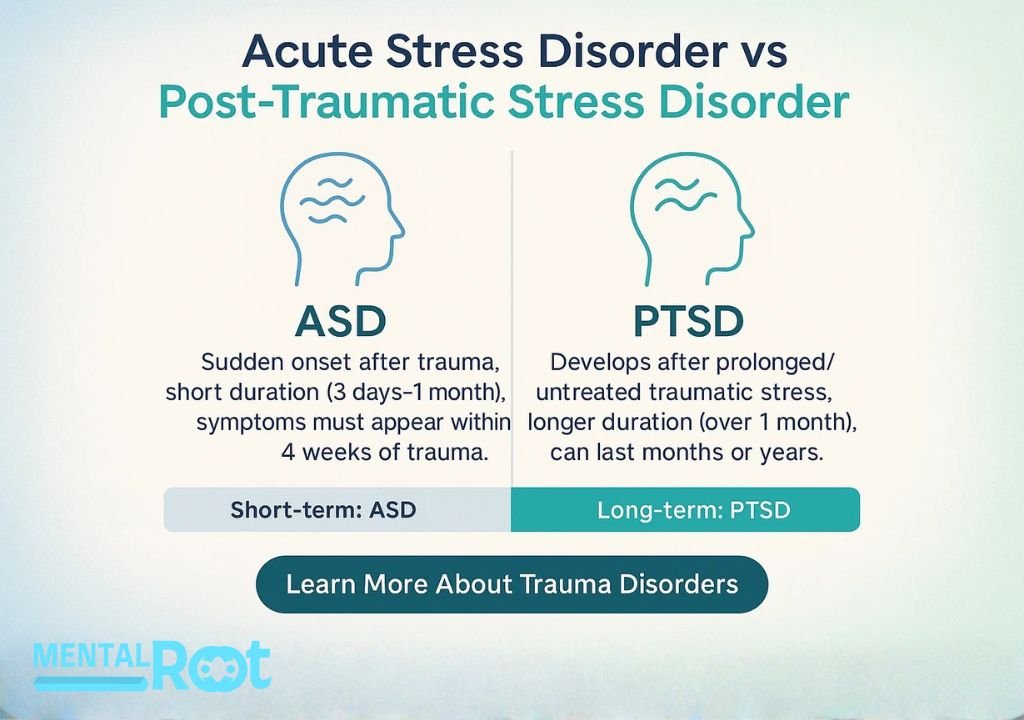
Acute stress disorder is a severe response to stress that lasts for three to four weeks after a traumatic event.
Post-traumatic stress disorder is a long-term mental illness with symptoms that have been present for more than one month. It is caused by a traumatic event and can last for months or even years.
The main difference between acute stress disorder and post-traumatic stress disorder is the time frame; they are separated by one month. However, many of their causes, risks, symptoms, and treatment options are the same.
I’m sure a lot of people have heard of PTSD, but they don’t really know what it means. In this article, we’ll talk about trauma and stressor-related disorders in more depth, with a focus on two: PTSD and acute stress disorder (ASD).
Trauma can happen to anyone; in fact, a survey by the World Health Organization found that 70% of people around the world would experience one or more traumatic events in their lifetime, with an average of three events per person.
Also, knowing the difference between ASD and PTSD is important for picking the right treatment and putting in place plans to stop the problems before they happen.
Here’s what you need to know before we get into the specifics: both ASD and PTSD begin with an acute stress reaction.
Get assessed for ASD or PTSD symptoms online and receive personalized support from a licensed provider.
Book an appointmentAn acute stress reaction, also known as the “fight-or-flight” response, starts as soon as you think or sense that you are in danger. It happens when adrenaline is released, and it only lasts for a short time (<72 hours).
Along with “fight or flight,” other ASR responses are “freeze,” “fright,” “faint,” and “fawn.”
There is another type of stress reaction called a traumatic stress reaction. This is caused by a traumatic event.
Stress and trauma are not the same thing.
When someone goes through something that hurts them physically or emotionally and causes long-lasting mental and emotional distress, along with possible physical, social, or spiritual effects, this is called trauma.
In other words, a traumatic stress response is worse and lasts longer than an acute stress response.
But why do some people get better in hours or days while others fight for months or years? It has to do with something called “fear conditioning,” which means that a normal or everyday thing is linked to the traumatic event and makes people remember how scared they were of it.
Here are two examples to show what I mean:
Let’s look at ASD and PTSD in more detail now.
Acute stress disorder (ASD) is a reaction to a traumatic event that lasts longer than 72 hours but is still pretty short-term. It changes a person’s mood, thoughts, and behavior.
There aren’t any general statistics about ASD after an acute stress reaction, which is a shame. There are, however, some estimates that come after certain traumatic events:
There are five main groups of possible ASD symptoms:
In the US and Canada, 6 to 9 out of every 100 people will get PTSD at some point in their lives. This is more likely to happen when trauma is planned, violent, or happens more than once than when it happens by accident.
PTSD is a long-term mental illness that lasts more than a month and is caused by a traumatic event that affected the person in some way. This makes them unhappy all the time, changes their thoughts and actions in big ways, and makes it hard for them to do many things in their daily lives. Relationship problems can be caused by problems communicating and feeling detached. Insomnia and anxiety caused by PTSD can make it hard to focus, which can lead to less work or school output or absences. At times, it can be hard to stick to daily routines and enjoy things that used to make you happy.
PTSD and ASD can share some of the same types of symptoms, but the most noticeable signs of PTSD are changes in mood and thought patterns that are not good. People who have PTSD also often:
The above-mentioned arousal, intrusion, and avoidance symptoms also happen and look a lot like those in ASD. The dissociative symptoms may also happen, but not as often as in ASD.
Consult an experienced healthcare provider online for PTSD evaluation and personalized support.
Talk to a specialist online|
ASD |
PTSD |
|
|
This means |
a mental illness that only lasts a short time after a traumatic event |
a long-lasting mental illness that happens after a traumatic event |
|
Start |
From three days after a hurt |
From at least one month after a traumatic event |
|
How long |
There are signs for three to four weeks. |
Symptoms that last longer than a month; can last for years |
|
In order of how noticeable they are, the symptoms |
|
|
|
How to Treat |
|
|
|
Results |
Nine out of ten people get better. |
About half (of them) are better in 3 months. After two years, one in three people still have symptoms. |
The main thing that sets ASD apart from PTSD is the time frame:
PTSD can last for years or months, but ASD only lasts a month or two.
A person can have PTSD years or even decades after the traumatic event. Sometimes this won’t happen until years after the event.
If a person has symptoms of delayed PTSD for at least one month, but no more than six months after the trauma, they may have it.
When someone has ASD, dissociative symptoms are more common than negative mood symptoms. When someone has PTSD, the opposite is true.
As a result of giving emotional and practical safety and support, it is important to provide “psychological first aid” right after the trauma.
Therapy is the best way to treat both conditions, but for PTSD, sessions need to last for months or even years. Medication has not been shown to help with ASD, but it may be given “off-label” if nothing else works. For example, some antidepressants are approved as a second-line treatment for PTSD.
Most people with ASD will get better with early treatment, but people with ASD are 24 times more likely to die by suicide, be depressed, anxious, or abuse drugs than people without ASD. People who get PTSD will still have symptoms about three out of ten years after they are diagnosed. This makes them more likely to commit suicide and makes it more likely for them to have long-term mental health problems, substance abuse, and job problems.
Call a crisis hotline right away if you’re having suicidal or self-harming thoughts. Some examples are 911, the toll-free 988 suicide & crisis lifeline, or Samaritans (116-123 or chat).
Some examples of potentially traumatic events that could lead to PTSD and maybe even ASD are
However, people don’t have to actually go through the event in order to develop ASD or PTSD. Just seeing or hearing about a close family member or friend’s experience can be enough. In some cases, a trigger could be even a vague reminder of a traumatic event that makes you feel bad.
Other people who might be at risk are
There are also things that can put a person at risk for getting PTSD or ASD:

An ASD consequence is PTSD. A person diagnosed with ASD may still have symptoms that might develop into PTSD in the future. As a consequence, PTSD may develop from acute stress disorder rather than happening simultaneously.
Stress is a typical physical response to every obstacle in life. As soon as the task is over, it normally goes away and becomes less severe. On the other hand, traumatic stress may be lethal and has a profound effect on an individual’s ability to operate.
Acute stress disorder lasts for the first few days after a traumatic incident, but post-traumatic stress disorder is a lasting consequence.
Indeed! Acute stress problems often resolve on their own. Early diagnosis and therapy prevent it from becoming worse or developing into PTSD.