

Evidence Based


Updated on: 28.08.2025
 12 min read
 Medical Disclaimer
The medicines listed on this website are provided for informational purposes only. Just because they are on the list doesn’t mean that anyone will be prescribed them; in the end, treatment decisions are up to the healthcare providers. This is not a complete list of all the medicines that can be prescribed. Depending on the patient’s specific health needs and circumstances, doctors may prescribe other medicines, even those that don’t contain stimulants.
 Boxed Warning: Adderall (Amphetamine/Dextroamphetamine Mixed Salts) and Ritalin (Methylphenidate)
Adderall and Ritalin have a boxed warning from the U.S. Food and Drug Administration (FDA), which is the most serious warning they can give. This is because they are very likely to be misused, abused, or become dependent on, which can cause serious heart problems and, in rare cases, death. Both drugs are classified as controlled substances because they have a high risk of being misused or leading to addiction. Because of this, there are strict federal and state rules about how much can be prescribed or given out in a certain amount of time.
 Highlights
Both Adderall and Ritalin are used to treat ADHD and narcolepsy, as well as several other conditions that aren’t officially recognized.
Amphetamine salts make up the active ingredient in Adderall, while methylphenidate makes up the active ingredient in Ritalin.
You can get both drugs as brand-name or generic versions, and they come in both immediate-release tablets and extended-release capsules.
Before starting treatment, you should fully understand the risks of serious side effects that come with both Adderall and Ritalin. Some of these are heart problems, movement disorders, serotonin syndrome, and drug abuse or dependence.
People with attention deficit hyperactivity disorder (ADHD) are often given Adderall and Ritalin, which are both stimulants. These drugs work well to control hyperactivity, impulsivity, and lack of attention. They also help boost energy and focus and make people feel better.
The main goal of both Ritalin and Adderall is to help with ADHD symptoms. But you should know that they differ slightly in how they work, how much you should take, what they are used for, how much they cost, and what side effects they may have. This article will cover all the essential info about Ritalin and Adderall and answer your questions with the latest data.
See a licensed medical provider online to assess your symptoms and receive a personalized ADHD treatment plan.
Get Medical HelpBoth Adderall and Ritalin are prescribed primarily for ADHD. In addition, the FDA has approved them to treat narcolepsy.
Adderall and Ritalin are both effective at controlling and managing all types of ADHD symptoms in approximately 70% [3] of cases. They help to improve concentration and reduce hyperactive and impulsive behavior, resulting in better social interactions and productivity at work or school.
According to a meta-analysis of 133 randomized trials , Adderall may be the better option in adults due to its efficacy and safety. In contrast, Ritalin may be more appropriate for children and adolescents.
The typical starting dose of Adderall for ADHD is 5 mg to 40 mg once or twice per day, in the morning and at noon. Ritalin, on the other hand, is typically prescribed for ADHD in the form of 20 mg or 30 mg tablets taken twice to three times per day in the morning, noon, and afternoon. In contrast, Adderall XR and Ritalin LA can be taken once a day because their effects last longer.
Dosages are determined separately for each patient based on their therapeutic needs and may change during treatment. Always consult your healthcare provider if you have any questions about the dosage.
Ritalin (methylphenidate) and Adderall (amphetamine-dextroamphetamine) are both central nervous system stimulants used to treat ADHD, but their composition, duration, and effects vary. Ritalin typically works faster and has a shorter duration, necessitating multiple doses per day, whereas Adderall lasts longer and may provide more sustained symptom control.
Despite these differences, both medications work by increasing dopamine and norepinephrine levels in the brain, which helps with focus, attention, and impulse control. They also have similar side effects, including insomnia, loss of appetite, and increased heart rate. The decision between them is based on an individual’s response, medical history, and a healthcare provider’s recommendation.
There are many similarities between Adderall and Ritalin. Both medicines:
Ritalin (methylphenidate) differs from other stimulant medications primarily in terms of its speed of action and duration of effect. It usually has a shorter duration, which may necessitate multiple doses throughout the day but allows for more versatile dosing. When compared to amphetamine-based alternatives, Ritalin may produce a milder stimulant effect for some people. It also has a slightly lower risk of long-term side effects, though individual responses may vary.
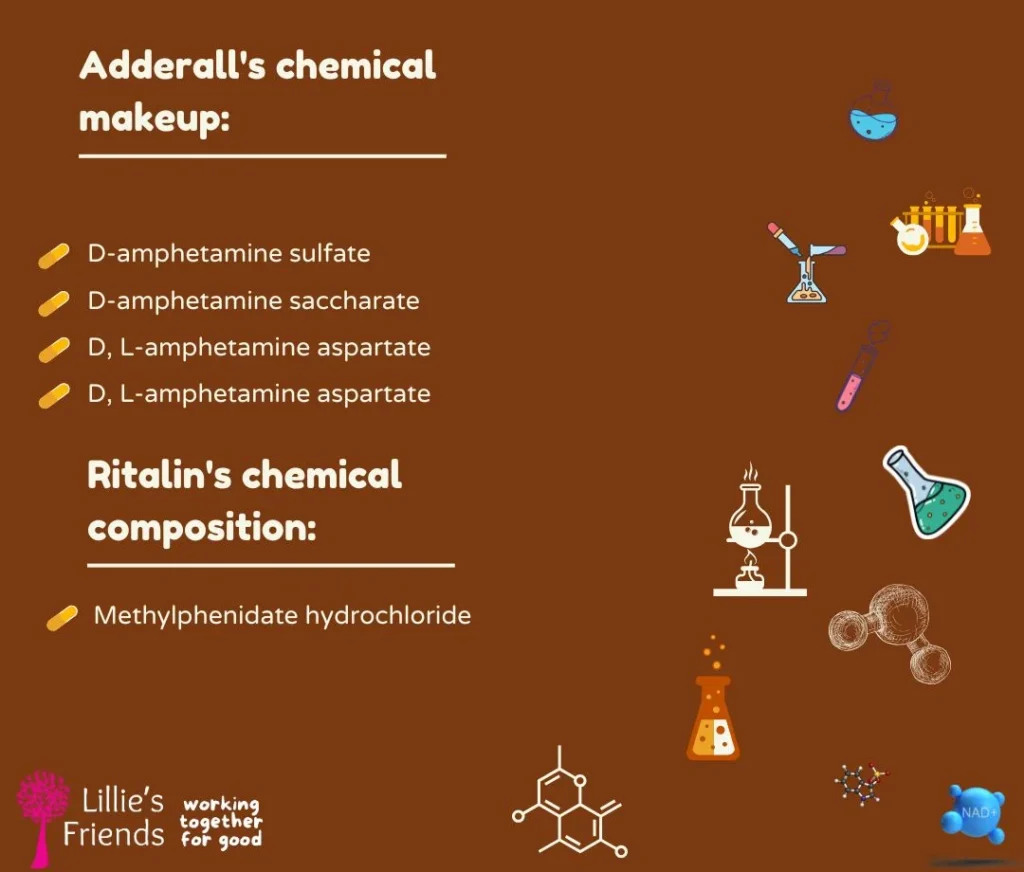
The main difference between Adderall and Ritalin is their active ingredient. Adderall is a mixture of four amphetamine salts, and Ritalin contains methylphenidate hydrochloride.
Amphetamines (Adderall) and methylphenidate (Ritalin) work by increasing the levels of dopamine, norepinephrine, and serotonin in the brain. Among other mechanisms, they reduce the reabsorption of these neurotransmitters, so their effects last longer. However, Ritalin and Adderall achieve these effects in different ways, and each medication has its unique functions along with shared ones.
Another significant distinction between Adderall and Ritalin is the duration of action, or how long the effects last.
As a result, their dosages are adjusted appropriately. Adderall is typically prescribed once or twice daily, whereas Ritalin requires multiple doses throughout the day to maintain its therapeutic effects.
However, slow-release versions of these medications are now available, including Adderall extended-release (Adderall XR), Ritalin sustained-release (Ritalin SR), and Ritalin extended-release (Ritalin LA). These medications reduce multiple dosing issues by remaining effective in the body for a longer period of time. The effects of Adderall XR last 10 to 12 hours, whereas Ritalin LA relieves symptoms for 8 to 10 hours.
Follow your doctor’s instructions and never exceed the recommended dosage.
Adderall is intended for use in children aged 3 and up. Ritalin is intended for children over the age of six.
Long-term use of either medication has not been extensively studied and should be approached with caution. There is a specific risk of long-term growth suppression. Children who take Adderall or Ritalin.
The price of Ritalin and Adderall varies depending on whether you purchase the generic or brand version. It also depends on your insurance plan’s coverage for these medications. For example, 60 generic Adderall tablets of 5 mg strength cost between $17.33 and $105.70. The same supply of a brand version costs between $777.69 and $937.19. Coupons can help you save money.
The generic version of Ritalin (methylphenidate) costs between $26.98 and $117.10 for 60 5 mg tablets. The same supply of a branded Ritalin ranges from $127.71 to $149.76. Again, coupons are available for this medication. Generic Adderall and Ritalin are also typically covered by insurance plans, including Medicare. Contact your insurance provider for complete coverage details.
Note: These are the average Adderall and Ritalin prices; the final cost of the medication may vary depending on your insurance plan and pharmacy.
Some strengths of the generic form of Adderall for immediate release are currently on backorder. Additionally, generic extended-release Ritalin is on backorder. When specific strengths or forms are in short supply, consult with your healthcare provider and pharmacy to find alternatives.
Some options include switching to brand versions, which often require additional insurance authorization and result in higher copays. Another option is to get a prescription for higher-dose tablets that you can break in half to get the right amount of medication. The FDA maintains the most up-to-date list of drug shortages in the United States.
|
Feature |
Ritalin |
Adderall |
|
Drug class |
CenRitalinrvouAdderall stimulant |
Central nervous system stimulant |
|
Mechanism of action. |
Increases neurotransmitter levels. |
Increases neurotransmitter levels. |
|
Chemical Composition |
Methylphenidate |
Amphetamine/dextroamphetamine salts. |
|
Available forms |
Ritalin Ritalin LA |
Adderall Adderall XR |
|
Available dosages: |
Ritalin tablets come in strengths of 5 mg, 10 mg, and 20 mg. Ritalin LA: 10 mg, 20 mg, 30 mg, and 40 mg capsules. |
Adderall tablets come in 5 mg, 7.5 mg, 10 mg, 12.5 mg, 15 mg, 20 mg, and 30 mg strengths. Adderall XR: 5 mg, 10 mg, 15 mg, 20 mg, 25 mg, and 30 mg capsules. |
|
Age of Use |
6 years or older. |
3 years or older. |
|
Duration of Action |
Ritalin — two to four hours. Ritalin LA — 8-10 hours |
Adderall — 4-6 hours Adderall XR — 10-12 hours |
Discuss the pros and cons of each medication and find the most suitable ADHD treatment for your needs.
Book an appointmentRitalin (methylphenidate) and Adderall (amphetamine-dextroamphetamine) are both stimulant medications used to treat ADHD, and their effects on the central nervous system are very similar. However, the severity and likelihood of certain effects may differ depending on the individual and the drug.
Ritalin and Adderall have very similar side effects because they are stimulants that work in the same way in the body. Remember that the intensity varies from person to person.
Common side effects of Ritalin and Adderall:
Ritalin and Adderall have less common, but serious, side effects.
Please keep in mind that this is not an exhaustive list of Ritalin and Adderall-related side effects. For any questions about the side effects, please contact your doctor or pharmacist.
While Ritalin (methylphenidate) is effective at treating ADHD symptoms, it also has some risks, particularly when misused, taken in large doses, or used without proper medical supervision.
Stimulants like Ritalin and Adderall raise the heart rate and blood pressure. This increases the patients’ chances of having a heart attack or stroke, especially if they already have a heart condition or have high blood pressure. According to research, Ritalin and Adderall have the same risk of causing a cardiovascular event in patients. As a result, before taking any stimulants, you must disclose your complete medical and medication history to your doctor.
Ritalin and Adderall are rarely associated with serious complications when used at recommended dosages. However, because of their abuse potential, these medications carry the risk of causing a fatal overdose. Severe stimulant overdose symptoms include rapid breathing, irregular heartbeat, confusion, delusions, tremors, panic attacks, convulsions, and coma.
Ritalin and Adderall have a high risk of drug abuse in people who take them in large doses for extended periods of time for non-medical reasons. It can cause physical and psychological dependence, which can lead to addictive behavior.
Ritalin and Adderall have similar interactions with several drug classes. Stimulants raise the plasma levels of medications by slowing their metabolism. These include tricyclic or tetracyclic antidepressants, phenytoin, warfarin, primidone, and so on. They may also reduce the effectiveness of certain antihypertensive medications, such as lisinopril and losartan. The following is a list of some of the most common stimulant drug interactions.
|
Drug Category |
Examples |
Potential Interaction/Risk |
|---|---|---|
|
MAO inhibitors (MAOI) |
Isocarboxazid, phenelzine, and selegiline |
Severe increase in blood pressure (hypertensive crisis); potentially fatal. |
|
General anesthetics |
Halothane, isoflurane, and desflurane. |
Increased risk of irregular heartbeat and cardiovascular instability |
|
Antihypertensive medications |
Amlodipine, Lisinopril, and Losartan |
Reduced efficacy of blood pressure medications |
|
Beta-Blockers |
Bisoprolol, metoprolol, and propranolol |
May cause abnormal heart responses or reduced therapeutic effect. |
|
Antidepressants (SSRIs, and Others) |
Trazodone, Fluoxetine and Sertraline |
Increased risk of serotonin syndrome (agitation, confusion, rapid heartbeat) |
Adderall may also make it difficult to measure corticosteroids in the body because it increases their levels.
Note: This is not an exhaustive list of all possible Adderall and Ritalin drug interactions. Please contact your doctor or pharmacist for more information.
Adderall and Ritalin both have contraindications, or situations that would make using the medication dangerous for a patient. If any of the following conditions apply to you, you should notify your doctor because taking Ritalin or Adderall may be dangerous. These contraindications include:
Adderall and Ritalin are potent stimulants used to treat ADHD and other medical conditions. There are minor differences in price, form, dosage, and drug interactions. Because of the risk of abuse, they are strictly regulated medications. However, when used in therapeutic doses as prescribed by a doctor, they effectively control ADHD symptoms in the majority of cases.
Our medical professionals have extensive experience developing personalized treatment plans for adults with ADHD. If you have any questions about ADHD medications, such as Ritalin and Adderall, you can schedule an appointment and speak with one of our healthcare providers online.

In most situations, Ritalin and Adderall are equally effective in reducing the symptoms of ADHD. A meta-analysis of 133 randomized studies suggests that Adderall could be the better choice for adults because of its safety and effectiveness. Ritalin, on the other hand, could be more appropriate for young people. However, depending on how each patient responds to the therapy, there may be a range of reactions to these treatments.
Since no known interactions between Adderall and Ritalin have been documented, it is unknown how these two medications interact. That does not, however, mean that Ritalin and Adderall have no interactions and may be used simultaneously without risk. There is a chance for major side effects, such as an overdose, since both medications function to generate the same result. Therefore, physicians advise against taking them both at once.
If one drug is not functioning well or is having serious adverse effects, it is feasible to go from Ritalin to Adderall and vice versa. It need to be taken as directed by a physician, with appropriate dosage modifications.
At the same dosage, Adderall is often twice as strong as Ritalin; for example, 5 mg of Adderall is equivalent to 10 mg of Ritalin. This implies that in order to have the same therapeutic effects as Adderall, you must take twice as much Ritalin. But only a doctor, after a thorough assessment of your symptoms, can decide how much medication is appropriate for your situation.
Further study is required to determine if Ritalin and Adderall usage during pregnancy and nursing is safe or detrimental. Because stimulants may result in birth malformations, experts advise avoiding taking them during pregnancy, particularly during the first three months.
Drinking alcohol while taking Ritalin or Adderall might exacerbate nervous system adverse effects include irritation, sleepiness, anxiety, and memory problems. It is thus not advised to combine alcohol and stimulants.
Due to strict regulations, you need a doctor’s prescription to purchase Adderall and Ritalin from pharmacies. Apart from going to the doctor in person, telemedicine services may also be used to get a prescription for Adderall and Ritalin. If specific requirements are satisfied,